The Divine Liturgy of St John Chrysostom · Step 15
The censing
«Temjanisja»
What happens
While the reader goes on with the Epistle, the deacon takes the censer, a vessel for burning incense. He asks the priest to bless the incense, then censes round the Holy Table (the altar) and the table of oblation, on the north side of the sanctuary. From the Holy Doors he censes the icons of Christ and the Theotokos (the Virgin Mary), the bishop's throne and the people, and he comes back to cense the Holy Table and the priest.
Who does what
- PriestBlesses the incense from the high place, saying its prayer quietly.
- DeaconTakes the censer, asks the priest to bless the incense, and censes the Holy Table, the table of oblation, the icons, the bishop's throne, the people and the priest.
- ReaderGoes on reading the Epistle.
- PeopleAre censed by the deacon from the Holy Doors as they listen to the Epistle.
When the priest serves without a deacon: Without a deacon the priest does the censing himself.
The words
The deacon takes the censer and says to the priest in a low voice: (translated by this site)
Dhiaku merr temjanicën dhe me zë të ulët i thotë priftit:
Bless, Master, the censer,
Beko, o Zot, temjamin.
The priest blesses it, saying in a low voice the Prayer of the Incense. (translated by this site)
Prifti e bekon atë, duke thënë me zë të ulët uratën e Temjamit.
Blessed is our God always, now, and ever, and unto ages of ages. Amen.
I bekuar është Perëndia ynë gjithnjë; tani e përherë, e në jetë të jetëve. Amin.
Unto thee, O Christ-God, do we offer incense for an odour of spiritual fragrance: which do thou accept upon thy most heavenly Altar, and pour forth upon us in return the grace of thine all-holy Spirit.
Temjamë po të blatojmë, o Krisht Perëndi, si e erë kundërmimi shpirtëror, të cilën pasi ta pranosh në altarin tënd përmbiqiellor, dërgona si shpërblim hirin e Shpirtit tënd të tërëshenjtë.
The deacon censes round the Holy Table and the holy table of oblation; and from the Holy Doors he censes the despotic icons, the bishop's throne and the people. He returns into the sanctuary and censes the Holy Table, the priest and all the priests. (translated by this site)
Dhiaku temjanis rreth Tryezës së Shenjtë, Proskomidhinë e shenjtë; dhe nga Dera e Bukur temjanis ikonat dhespotike, fronin arkieratik edhe popullin. Kthehet në Hierore, temjanis Tryezën e Shenjtë, priftin dhe gjithë priftërinjtë.
The Albanian text is the Orthodox Autocephalous Church of Albania’s, used with permission. orthodoxalbania.org. The English is from Isabel F. Hapgood’s Service Book (1922).
What it means
«This censing of the Temple, in preparation for listening to the reading of the Holy Gospel, draws the thoughts of the worshippers on high, and typifies the grace of the Holy Spirit, which is shed abroad in all the world, giving to the heart of man the savour of the sweetness of Christ (2 Cor. ii. 15). It is also a sign of prayerful reverence and homage to the Holy Gospel, as a symbol of the Holy Spirit, which is bestowed upon the world through the Gospel.»«During the chanting of the "Alleluia," the censer is swung in allusion to the grace of God vouchsafed through His Word.»Sokolof, A Manual of the Orthodox Church's Divine Services (1899), p. 66
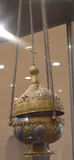 Censer
 Icon