Words of the services · Vestments
Crozier
Shkop · Greek: πατερίτσα / ποιμαντορικὴ ῥάβδος
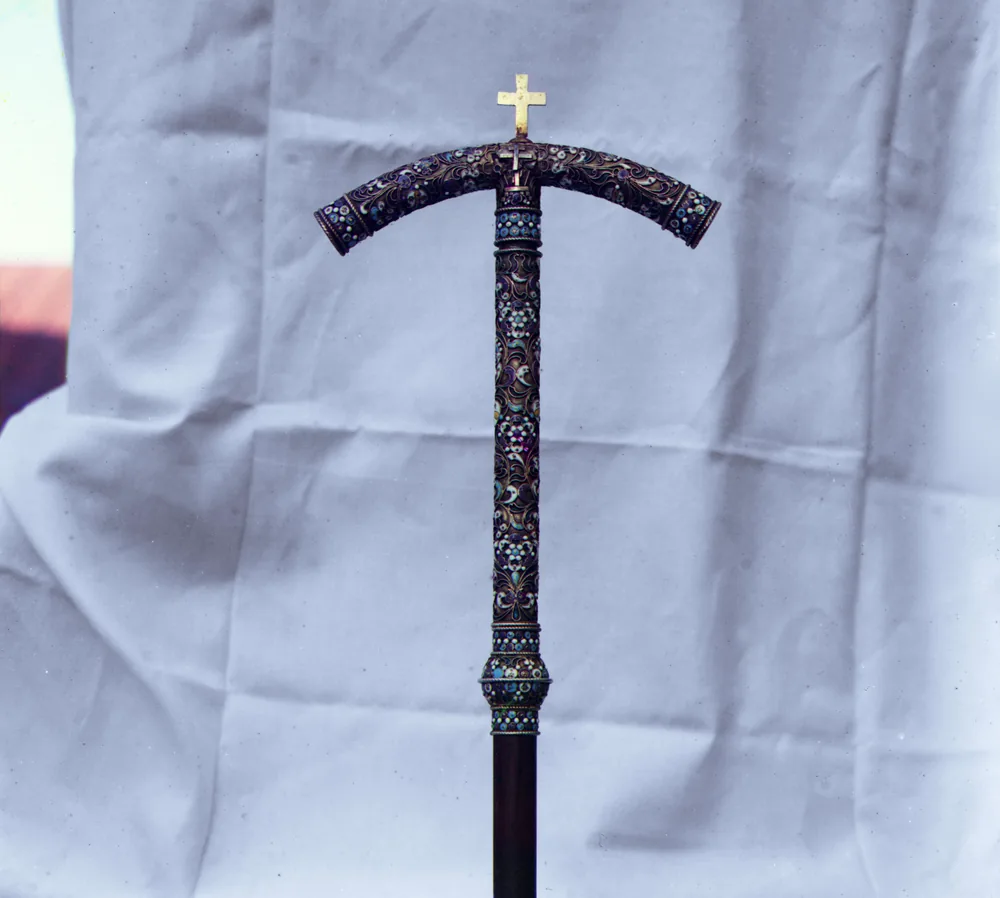
The bishop's pastoral staff. Its top has a double crook, its ends usually made like serpents' heads, with a cross above it. Bishops took it up, with the mitre and the sakkos, after the Christian empire fell to the Turks in the fifteenth century. In Russian usage a piece of fine cloth, usually silk, is tied below the crook for the hand; the staff is also given to archimandrites and hegumens, and a crozier-bearer goes out with it to meet the bishop at the western door.
What it means
«The crozier became the symbol of the rod of Aaron (Exodus 4:2), and so on.»«Veshjet», the Church of Albania · translated by this site
«The Crozier, or Pastoral Staff (Pósokh), is given to Bishops and to Archimandrites, in token of their spiritual authority over the monasteries or cities which they rule; and as a sign that it behooves them to feed the flock of Christ.»«The crook is usually made like serpents' heads at both ends, in memory of the Savior's words: " Be wise like unto serpents." As the serpent is renovated yearly, casting off its old slough and forcing its way through thorny plants, so the bishop, while guiding his flock, must follow himself and lead others along the path of enlightenment and renovation, in despite of sorrows and sufferings.»Sokolof, A Manual of the Orthodox Church's Divine Services (1899), p. 32