Great Vespers on Saturday evening · Step 7
«Lord, I have cried» and the censing
«Thirrtoret dhe temjanisja»
What happens
The chanters sing «Lord, I have cried», Psalms 140 and 141 (in the Greek numbering), in the tone of the week (one of the eight musical modes). When they reach «Let my prayer be set forth before thee as incense», the deacon asks the priest's blessing on the incense and censes the sanctuary (the altar area) and the church.
Who does what
- PriestBlesses the incense with the prayer «Unto thee, O Christ-God, do we offer incense for an odour of spiritual fragrance...».
- DeaconAt «Let my prayer be set forth», takes the censer, asks «Bless, Master, the censer» and censes the sanctuary and the church.
- ChantersSing Psalms 140 and 141 in the tone of the week.
- PeopleListen to the psalms, standing or seated as they wish, and are censed with the rest of the church.
When the priest serves without a deacon: Without a deacon the priest blesses the incense and censes the sanctuary and the church himself, as the Church's book directs.
The words
O Lord, I have cried to thee; Let my prayer be set forth before thee as incense;
Pastaj psalet «O Zot, thirra te Ty» me troparet e tij të ditës sipas tingullit që të rastisë. Kur psalet «Le të drejtohet falja ime si temjam» dhiaku merr temjanicën dhe temjanis Hieroren dhe kishën pasi më parë kërkon bekimin e priftit.
Bless, Master, the censer,
Beko, o Zot, temjamin.
Unto thee, O Christ-God, do we offer incense for an odour of spiritual fragrance: which do thou accept upon thy most heavenly Altar, and pour forth upon us in return the grace of thine all-holy Spirit.
Temjam po të blatojmë, o Krisht Perëndi, si erë kundërmimi shpirtëror, të cilën pasi ta pranosh në altarin tënd përmbiqiellor, dërgona si shpërblim hirin e shpirtit tënd të tërëshenjtë.
In the absence of a deacon, the priest does the censing. (translated by this site)
Në mungesë dhiaku, temjanisjen e bën prifti.
The chanters sing Psalm 140: (translated by this site)
Psaltët psalin psalmin 140:
O Lord, I have cried to thee; hear me: attend to the voice of my supplication, when I cry to thee. Let my prayer be set forth before thee as incense; the lifting up of my hands [as] an evening sacrifice.
O Zot, thirra te Ty, dëgjomë, dëgjomë, o Zot. O Zot, thirra te Ty, dëgjomë, vëri re zërit të lutjes sime; kur thërres te Ty, o Zot, dëgjomë. Le të drejtohet lutja ime si temjam përpara teje; ngritja e duarve të mia si therore e mbrëmshme. O Zot, dëgjomë.
Set a watch, O Lord, on my mouth, and a strong door about my lips.
Vëri roje gojës sime, o Zot; dhe derë si gardh buzëve të mia.
Incline not my heart to evil things, to employ pretexts for sins, with men who work iniquity: and let me not unite with their choice ones.
Mos ma ler zemrën të rrëshqasë në fjalë të këqia për të arsyetuar mëkatet. Bashkë me njerëz që bëjnë paudhësi dhe të mos kem lidhje me vepra të zgjedhura prej tyre.
The righteous shall chasten me with mercy, and reprove me: but let not the oil of the sinner anoint my head: for yet shall my prayer also be in their pleasures. Their mighty ones have been swallowed up near the rock:
I drejti më dënon dhe më qorton nga mëshira, por vaj mëkatari mos leftë kryet tim. Se unë lutem edhe kur ata duken të lumtur; u përmbysshin si prej shkëmbi udhëheqësit e tyre.
they shall hear my words, for they are sweet. As a lump of earth is crushed upon the ground, our bones have been scattered by the [mouth of] the grave.
Do të dëgjojnë thëniet e mia se janë të ëmbla. Si një brazdë që çahet në tokë, le të shpërndahen eshtrat e tyre pranë ferrit.
For mine eyes are to thee, O Lord God: I have hoped in thee; take not away my life.
Se tek ty, o Zot, janë sytë e mi, tek ty, o Zot, kam shpresuar, mos e prish shpirtin tim.
Keep me from the snare which they have set for me, and from the stumbling-blocks of them that work iniquity.
Ruajmë prej kurthit që më ngritën, dhe prej skandaleve të atyre që bëjnë paudhësira.
Sinners shall fall by their own net: I am alone until I shall escape.
Do të bien fajtorët në rrjetat e ngritura prej tyre, ndërsa mua ruajmë gjersa të kaloj.
Psalm 141 (translated by this site)
Psalmi 141
I cried to the Lord with my voice; with my voice I made supplication to the Lord.
Me zërin tim i thirra Zotit, me zërin tim iu luta Zotit.
I will pour out before him my supplication: I will declare before him mine affliction.
Do të derdh përpara tij lutjen time; përpara tij do të rrëfej hidhërimin tim.
When my spirit was fainting within me, then thou knewest my paths;
Kur ishte duke m'u shterur fryma, ti njohe udhët mia.
in the very way wherein I was walking, they hid a snare for me.
Në këtë rrugë që ecja, më ngritën fshehurazi kurth.
I looked on [my] right hand, and behold, for there was none that noticed me;
Shtija sytë djathtas dhe vështroja, por askush s'më njihte.
refuge failed me; and there was none that cared for my soul.
Humbi çdo strehë shpëtimi për mua, dhe s'ka kush kujdeset për shpirtin tim.
I cried unto thee, O Lord, and said, Thou art my hope, my portion in the land of the living.
Te ty thirra, o Zot, dhe thashë: Ti je shpresa ime, Ti je përkrahja ime te dheu i të gjallëve.
Attend to my supplication, for I am brought very low;
Vëri veshin lutjes sime, se jam i munduar fort.
deliver me from them that persecute me; for they are stronger than I.
Shpëtomë prej ndjekësve të mi, se janë bërë më të fortë se unë.
The Albanian text is the Orthodox Autocephalous Church of Albania’s, used with permission. orthodoxalbania.org. The English is from Isabel F. Hapgood’s Service Book (1922).
What it means
«Repentance for sins committed calls forth in the human soul entreaty for mercy. Therefore, after the Kathisma, selected verses from the Psalms are read (" O Lord, I have cried unto Thee, hearken to me"), in which are expressed: in the first place, supplication from the bottom of the heart, that the Lord may hearken to our unworthy prayers, help us to keep away from evil and from evil men, and receive us among his elect; in the second place, the assurance that the Lord will hear our prayer.»Sokolof, A Manual of the Orthodox Church's Divine Services (1899), p. 43
«Its burning symbolizes prayer addressed to God, as Psalm 140:2 also says, “Let my prayer be set forth before thee as incense”, as does St John the Evangelist in his vision, in the book of Revelation 8:3-4: “And another angel came and stood at the altar, holding a golden censer; and there was given unto him much incense, that he should offer it with the prayers of all the saints upon the golden altar which is before the throne of God. And the smoke of the incense went up with the prayers of the saints out of the angel's hand before God”.»«Temjani», the Church of Albania · translated by this site
«The Magi too (the wise men of the East) offered incense to the newborn Christ (Matthew 2:11). So too the priest, in the services of the Church, before he begins the censing with incense, says: “Unto thee, O Christ-God, do we offer incense for an odour of spiritual fragrance: which do thou accept upon thy most heavenly Altar, and pour forth upon us in return the grace of thine all-holy Spirit”.»«Temjani», the Church of Albania · translated by this site
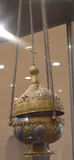 Censer