The Fathers on the Gospels
← All topics

Topic

The Holy Mysteries

The Church confesses that in the Holy Mysteries, which flowed from the side of Christ on the Cross, God gives an invisible grace through visible things: water, oil, bread and wine, sanctified by the word and the invocation of the Holy Spirit, are no longer common (the bread and wine are the Body and Blood of Christ), and those who receive them in faith are made partakers of Christ. Among them are the Holy Chrism, the seal of the gift of the Holy Spirit given to the newly baptized, and Marriage, which God instituted in the beginning and Christ honoured at Cana: a great mystery, concerning Christ and the Church. Here the Fathers teach this faith in their own words.

16 passages from 5 Fathers, drawn from 6 works.

The Visible Sign and the Hidden Grace

St. Cyril of Jerusalem

The Catechetical Lectures, Lecture III: On Baptism

Regard not the Laver as simple water, but rather regard the spiritual grace that is given with the water. For just as the offerings brought to the heathen altars, though simple in their nature, become defiled by the invocation of the idols, so contrariwise the simple water having received the invocation of the Holy Ghost, and of Christ, and of the Father, acquires a new power of holiness.

St. John Chrysostom

Homilies on the Gospel of Matthew, Homily LXXXII (Matthew 26:26-28)

Let us then in everything believe God, and gainsay Him in nothing, though what is said seem to be contrary to our thoughts and senses, but let His word be of higher authority than both reasonings and sight. Thus let us do in the mysteries also, not looking at the things set before us, but keeping in mind His sayings.

For His word cannot deceive, but our senses are easily beguiled. That hath never failed, but this in most things goeth wrong. Since then the word saith, “This is my body,” let us both be persuaded and believe, and look at it with the eyes of the mind.

For Christ hath given nothing sensible, but though in things sensible yet all to be perceived by the mind. So also in baptism, the gift is bestowed by a sensible thing, that is, by water; but that which is done is perceived by the mind, the birth, I mean, and the renewal. For if thou hadst been incorporeal, He would have delivered thee the incorporeal gifts bare; but because the soul hath been locked up in a body, He delivers thee the things that the mind perceives, in things sensible.
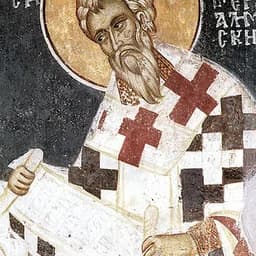
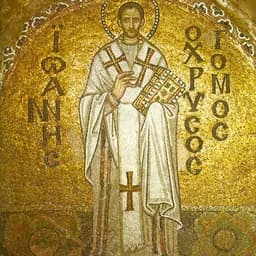
St. Augustine of Hippo

Tractates on the Gospel of John, Tractate LXXX (John 15:1–3)

Why does He not say, Ye are clean through the baptism wherewith ye have been washed, but “through the word which I have spoken unto you,” save only that in the water also it is the word that cleanseth? Take away the word, and the water is neither more nor less than water. The word is added to the element, and there results the Sacrament, as if itself also a kind of visible word. For He had said also to the same effect, when washing the disciples’ feet, “He that is washed needeth not, save to wash his feet, but is clean every whit.” And whence has water so great an efficacy, as in touching the body to cleanse the soul, save by the operation of the word; and that not because it is uttered, but because it is believed? For even in the word itself the passing sound is one thing, the abiding efficacy another.

Blood and Water from His Side

St. John Chrysostom

Homilies on the Gospel of John, Homily LXXXV (John 19:16-18)

With this too an ineffable mystery was accomplished. For “there came forth water and blood.” Not without a purpose, or by chance, did those founts come forth, but because by means of these two together the Church consisteth. And the initiated know it, being by water indeed regenerate, and nourished by the Blood and the Flesh. Hence the Mysteries take their beginning; that when thou approachest to that awful cup, thou mayest so approach, as drinking from the very side.

St. Augustine of Hippo

Tractates on the Gospel of John, Tractate CXX (John 19:31–42; 20:1–9)

A suggestive word was made use of by the evangelist, in not saying pierced, or wounded His side, or anything else, but “opened;” that thereby, in a sense, the gate of life might be thrown open, from whence have flowed forth the sacraments of the Church, without which there is no entrance to the life which is the true life. That blood was shed for the remission of sins; that water it is that makes up the health-giving cup, and supplies at once the laver of baptism and water for drinking. This was announced beforehand, when Noah was commanded to make a door in the side of the ark, whereby the animals might enter which were not destined to perish in the flood, and by which the Church was prefigured. Because of this, the first woman was formed from the side of the man when asleep, and was called Life, and the mother of all living. Truly it pointed to a great good, prior to the great evil of the transgression (in the guise of one thus lying asleep). This second Adam bowed His head and fell asleep on the cross, that a spouse might be formed for Him from that which flowed from the sleeper’s side. O death, whereby the dead are raised anew to life!

The Holy Chrism

St. Cyril of Jerusalem

The Catechetical Lectures, Mystagogical Lecture III

But beware of supposing this to be plain ointment. For as the Bread of the Eucharist, after the invocation of the Holy Ghost, is mere bread no longer, but the Body of Christ, so also this holy ointment is no more simple ointment, nor (so to say) common, after invocation, but it is Christ’s gift of grace, and, by the advent of the Holy Ghost, is made fit to impart His Divine Nature. Which ointment is symbolically applied to thy forehead and thy other senses; and while thy body is anointed with the visible ointment, thy soul is sanctified by the Holy and life-giving Spirit.

The Catechetical Lectures, Mystagogical Lecture III

And ye were first anointed on the forehead, that ye might be delivered from the shame, which the first man who transgressed bore about with him everywhere; and that with unveiled face ye might reflect as a mirror the glory of the Lord. Then on your ears; that ye might receive the ears which are quick to hear the Divine Mysteries, of which Esaias said, The Lord gave me also an ear to hear; and the Lord Jesus in the Gospel, He that hath ears to hear let him hear. Then on the nostrils; that receiving the sacred ointment ye may say, We are to God a sweet savour of Christ, in them that are saved. Afterwards on your breast; that having put on the breast-plate of righteousness, ye may stand against the wiles of the devil. For as Christ after His Baptism, and the visitation of the Holy Ghost, went forth and vanquished the adversary, so likewise ye, after Holy Baptism and the Mystical Chrism, having put on the whole armour of the Holy Ghost, are to stand against the power of the adversary, and vanquish it, saying, I can do all things through Christ which strengtheneth me.

The Catechetical Lectures, Mystagogical Lecture III

Having been counted worthy of this Holy Chrism, ye are called Christians, verifying the name also by your new birth. For before you were deemed worthy of this grace, ye had properly no right to this title, but were advancing on your way towards being Christians.

6. Moreover, you should know that in the old Scripture there lies the symbol of this Chrism. For what time Moses imparted to his brother the command of God, and made him High-priest, after bathing in water, he anointed him; and Aaron was called Christ or Anointed, evidently from the typical Chrism. So also the High-priest, in advancing Solomon to the kingdom, anointed him after he had bathed in Gihon. To them however these things happened in a figure, but to you not in a figure, but in truth; because ye were truly anointed by the Holy Ghost. Christ is the beginning of your salvation; for He is truly the First-fruit, and ye the mass; but if the First-fruit be holy, it is manifest that Its holiness will pass to the mass also.

This Is a Great Mystery

St. Ignatius of Antioch

The Epistle to Polycarp, Chapter V

Speak to my sisters, that they love the Lord, and be satisfied with their husbands both in the flesh and spirit. In like manner also, exhort my brethren, in the name of Jesus Christ, that they love their wives, even as the Lord the Church. If any one can continue in a state of purity, to the honour of Him who is Lord of the flesh, let him so remain without boasting. If he begins to boast, he is undone; and if he reckon himself greater than the bishop, he is ruined. But it becomes both men and women who marry, to form their union with the approval of the bishop, that their marriage may be according to God, and not after their own lust. Let all things be done to the honour of God.

St. Cyril of Jerusalem

The Catechetical Lectures, Lecture IV: On the Ten Points of Doctrine

Nor again, on the other hand, in maintaining thy chastity be thou puffed up against those who walk in the humbler path of matrimony. For as the Apostle saith, Let marriage be had in honour among all, and let the bed be undefiled. Thou too who retainest thy chastity, wast thou not begotten of those who had married? Because thou hast a possession of gold, do not on that account reprobate the silver. But let those also be of good cheer, who being married use marriage lawfully; who make a marriage according to God’s ordinance, and not of wantonness for the sake of unbounded license; who recognise seasons of abstinence, that they may give themselves unto prayer; who in our assemblies bring clean bodies as well as clean garments into the Church; who have entered upon matrimony for the procreation of children, but not for indulgence.

St. John Chrysostom

Homilies on the Gospel of Matthew, Homily LXII (Matthew 19:1)

But mark Him arguing strongly not from the creation only, but also from His command. For He said not, that He made one man and one woman only, but that He also gave this command that the one man should be joined to the one woman. But if it had been His will that he should put this one away, and bring in another, when He had made one man, He would have formed many women.

But now both by the manner of the creation, and by the manner of lawgiving, He showed that one man must dwell with one woman continually, and never break off from her.

And see how He saith, “He which made them at the beginning, made them male and female,” that is, from one root they sprung, and into one body came they together, “for the twain shall be one flesh.”

St. Augustine of Hippo

Tractates on the Gospel of John, Tractate IX (John 2:1–11)

The Lord, in that He came to the marriage to which He was invited, wished, apart from the mystical signification, to assure us that marriage was His own institution. For there were to be those of whom the apostle spoke, “forbidding to marry,” and asserting that marriage was an evil, and of the devil’s institution: notwithstanding the same Lord declares in the Gospel, on being asked whether it be lawful for a man to put away his wife for any cause, that it is not lawful save for the cause of fornication. In His answer, if you remember, He said, “What God hath joined together let not man put asunder.” And they that are well instructed in the catholic faith know that God instituted marriage; and as the union of man and wife is from God, so divorce is from the devil.

St. Bede the Venerable

As preserved in the Catena Aurea on John

His condescension in coming to the marriage, and the miracle He wrought there, are, even considering them in the letter only, a strong confirmation of the faith. Therein too are condemned the errors of Tatian, Marcion, and others who detract from the honor of marriage. For if the undefiled bed, and the marriage celebrated with due chastity, partook at all of sin, our Lord would never have come to one. Whereas now, conjugal chastity being good, the continence of widows better, the perfection of the virgin state best, to sanction all these degrees, but distinguish the merit of each, He deigned to be born of the pure womb of the Virgin; was blessed after birth by the prophetic voice of the widow Anna; and now invited in manhood to attend the celebration of a marriage, honors that also by the presence of His goodness.

Guard the Mystery

St. Cyril of Jerusalem

The Catechetical Lectures, Procatechesis

When, therefore, the Lecture is delivered, if a Catechumen ask thee what the teachers have said, tell nothing to him that is without. For we deliver to thee a mystery, and a hope of the life to come. Guard the mystery for Him who gives the reward. Let none ever say to thee, What harm to thee, if I also know it? So too the sick ask for wine; but if it be given at a wrong time it causes delirium, and two evils arise; the sick man dies, and the physician is blamed. Thus is it also with the Catechumen, if he hear anything from the believer: both the Catechumen becomes delirious (for he understands not what he has heard, and finds fault with the thing, and scoffs at what is said), and the believer is condemned as a traitor. But thou art now standing on the border: take heed, pray, to tell nothing out; not that the things spoken are not worthy to be told, but because his ear is unworthy to receive. Thou wast once thyself a Catechumen, and I described not what lay before thee. When by experience thou hast learned how high are the matters of our teaching, then thou wilt know that the Catechumens are not worthy to hear them.

The Catechetical Lectures, Mystagogical Lecture I

I have long been wishing, O true-born and dearly beloved children of the Church, to discourse to you concerning these spiritual and heavenly Mysteries; but since I well knew that seeing is far more persuasive than hearing, I waited for the present season; that finding you more open to the influence of my words from your present experience, I might lead you by the hand into the brighter and more fragrant meadow of the Paradise before us; especially as ye have been made fit to receive the more sacred Mysteries, after having been found worthy of divine and life-giving Baptism. Since therefore it remains to set before you a table of the more perfect instructions, let us now teach you these things exactly, that ye may know the effect wrought upon you on that evening of your baptism.

St. John Chrysostom

Homilies on the Gospel of Matthew, Homily XXIII (Matthew 7:1)

Let them hearken, who shamelessly associate with all, and make the awful things contemptible. For the mysteries we too therefore celebrate with closed doors, and keep out the uninitiated, not for any weakness of which we have convicted our rites, but because the many are as yet imperfectly prepared for them. For this very reason He Himself also discoursed much unto the Jews in parables, “because they seeing saw not.” For this, Paul likewise commanded “to know how we ought to answer every man.”