The feasts of the year · Pascha · 2 May 2027
The Resurrection
Ngjallja e Zotit Krisht
Pascha is the feast of Christ's Resurrection, the Feast of Feasts. Its name comes from the Hebrew pesah, “passage”: the passage from death to life and from earth to heaven. It falls on the first Sunday after the full moon on or after 21 March of the Julian calendar, never before or together with the Jewish Passover, and all the movable feasts depend on it. The vigil begins a little before midnight on Holy Saturday, in a church kept almost dark. The priest lights the Paschal candle from the unsleeping lamp and comes to the Holy Doors singing “Come, receive the light.” At midnight the people go out in procession, the Gospel of the Resurrection is sung outside the church, and the troparion “Christ is risen from the dead” is sung for the first time; it opens every service of the Paschal season. Matins is sung through, with the canon ascribed to St John of Damascus, while the celebrant cries “Christ is risen!” and the faithful answer “Truly He is risen!” The Paschal homily of St John Chrysostom is proclaimed, and the Divine Liturgy of St John Chrysostom follows.
The icon, explained
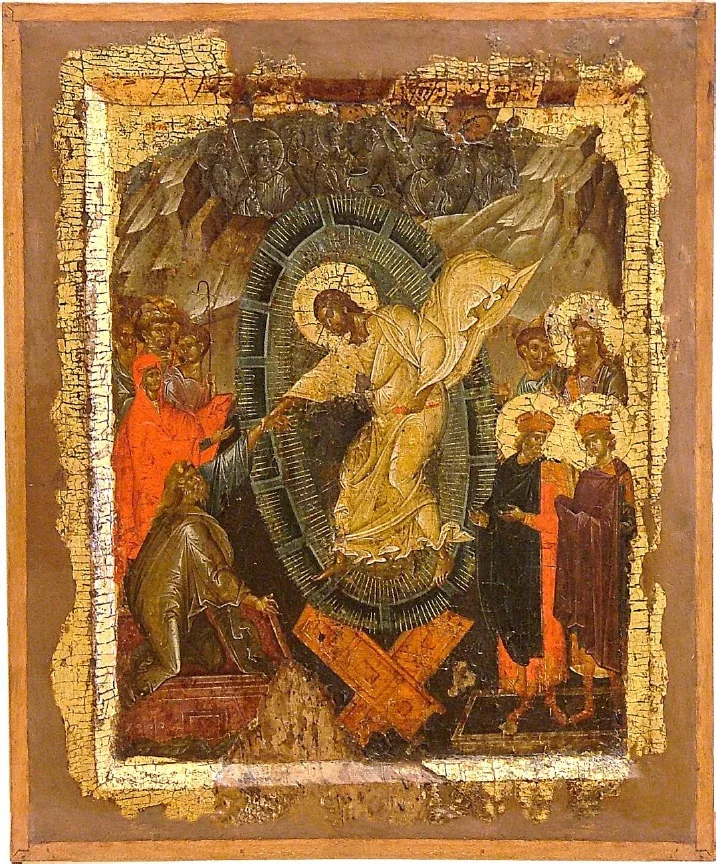
Choose a number on the icon, or a name in the list, to see what is painted there and what it means.
How the painters' Guide of Mount Athos describes it
«Hell, like a dark cave, beneath the mountains. Radiant angels chain Beelzebub, the Prince of Darkness; they strike at other demons, and pursue others with their lances. Several men, naked and fettered, look upwards. A large number of broken locks may be seen. The gates of hell are cast down; Christ tramples them beneath His feet. The Saviour takes Adam by the right hand, and Eve by the left. To the left of the Saviour; the Harbinger points to Him with his forefinger. David is near Him, as well as other righteous kings, with crowns and aureoles. To the left the Prophets Jonas, Isaiah, and Jeremiah; the righteous Abel, and many others with aureoles. A brilliant light and crowd of angels all around.»The Byzantine Guide to Painting, tr. M. Stokes, in Didron, Christian Iconography II (1886), p. 319
«The tomb half open; two angels, clothed in white, seated at each end. Christ tramples on the stone which covered the tomb. He blesses with the right hand, while He holds the banner with the golden cross in the left. Some of the soldiers below take flight; others lie, as if dead, upon the ground. In the distance are the women carrying myrrh.»The Byzantine Guide to Painting, tr. M. Stokes, in Didron, Christian Iconography II (1886), p. 319
The readings
- Epistle
- Gospel
The hymns of the feast
Christ is risen from the dead, trampling down Death by death, and upon those in the tomb bestowing life.Krishti u ngjall së vdekurish, me vdekje vdekjen shkeli edhe të varrosurve jetën u fali
«E Diela e Shenjtë e Pashkës së Madhe.», the Church of Albania
What the Church says of it
«In the Orthodox Church the feast of the Resurrection is called Pascha, a word that means Passage. This is the new Passage of the New and eternal Covenant, foretold by the prophets of old. This is the eternal Passage from death to life and from earth to heaven.»«E Diela e Shenjtë e Pashkës së Madhe.», the Church of Albania · translated by this site
«The icon of Pascha which stands in the middle of the church shows Christ destroying the gates of Hades and freeing Adam and Eve from the bondage of death. It is the image of the Victory, of “trampling down Death by death”.»«E Diela e Shenjtë e Pashkës së Madhe.», the Church of Albania · translated by this site
«They go round the church, bearing witness to Christ's victory over the powers of darkness and death. The whole universe has been washed, restored and saved through the entry of the Life of the World into death.»«E Shtuna e Madhe», the Church of Albania · translated by this site
«This is the Day of the Kingdom of God, the day “that has no night”, for “its lamp is the Lamb” (Revelation 21:22–25).»«E Diela e Shenjtë e Pashkës së Madhe.», the Church of Albania · translated by this site
Read more on the site
- The Resurrection · the Gospel with the Fathers
- The Prologue: In the Beginning Was the Word · the Gospel with the Fathers
- The Resurrection · a topic