Great Vespers on Saturday evening · Step 10
The entrance
«Hyrja»
What happens
While the chanters sing the dogmatikon, a hymn to the Theotokos (the Virgin Mary), the deacon takes the censer, the vessel for incense. With a light carried before them, he and the priest go out by the north door, a side door of the iconostasis (the icon screen). They stop at the appointed place, where the priest blesses the entrance. Then the deacon makes the sign of the cross with the censer and calls «Wisdom. Stand upright».
Who does what
- PriestSays the prayer of the entrance quietly. At the appointed place the Church's book has him kiss the Gospel book, which the deacon hands him; he then quietly blesses the entrance: «Blessed is the Entrance...».
- DeaconCarries the censer. Pointing east with his orarion (stole), asks «Bless, Master, the Holy Entrance». Then makes the sign of the cross with the censer, lifts it to head height and calls «Wisdom. Stand upright».
- Altar serversWhere an altar server carries the light, he goes out of the north door first, ahead of the clergy; the Church's book does not say who carries it.
- ChantersSing the dogmatikon of the tone, the musical mode of the week, while the entrance is made.
- PeopleWatch the light and the censer as they are carried out; by custom they stand at «Wisdom. Stand upright».
When the priest serves without a deacon: Without a deacon the priest goes out alone with the censer, the light before him, and himself makes the sign of the cross with the censer and calls «Wisdom. Stand upright».
The words
The deacon takes the censer and goes out with the priest by the north door, with a candlestick carried before them, and they go and stand in the appointed place. During the entrance the priest says the prayer of the entrance: (translated by this site)
Dhiaku merr temjanicën, del jashtë bashkë me priftin nga dera e veriut me manal përpara, dhe venë e qëndrojnë në vendin e caktuar. Gjatë hyrjes prifti thotë uratën e hyrjes:
In the evening, and in the morning, and at noonday we praise thee, we bless thee, we give thanks unto thee, and we pray unto thee, O Lord of all: Direct thou our prayer before thee as incense, and incline not our hearts unto words or thoughts of wickedness; but deliver us from all who seek after our souls. For unto thee, Lord, O Lord, lift we up our eyes, and in thee have we trusted. Put us not to shame, O our God.
(pa zë) Në mbrëmje, në mëngjes dhe në drekë, të lavdërojmë, të bekojmë; të falenderojmë dhe të lutemi, o Zot i të gjithave, o Zot njeridashës. Drejtoje faljen tonë si temjam përpara teje, dhe mos i ler zemrat tona të rrëshqasin në fjalë ose në mendime të këqia, por shpëtona nga gjithë ata që gjuajnë shpirtrat tanë; se tek Ti, o Zot, o Zot, janë sytë tanë dhe më Ty shpresuam; mos na turpëro, o Perëndia ynë.
For unto thee are due all glory, honour and worship, to the Father, and to the Son, and to the Holy Spirit, now, and ever, and unto ages of ages. Amen.
Se Ty të përket tërë lavdia, nderimi dhe adhurimi, Atit, e Birit edhe Shpirtit të Shenjtë, tani e përherë e në jetë të jetëve. Amin.
The deacon gives the holy Gospel book to the priest, and the priest kisses it. Then the deacon, pointing towards the East with his orarion, says to the priest. (translated by this site)
Dhiaku i jep priftit Ungjillin e shenjtë dhe prifti e puth. Pastaj dhiaku i thotë priftit duke treguar drejt Lindjes me Orarin.
Bless, Master, the Holy Entrance.
Beko, o Zot, Hyrjen e shenjtë.
Blessed is the Entrance of thy Holy Ones, now, and ever, and unto ages of ages.
(pa zë duke bekuar hyrjen): E bekuar është hyrja e shenjtorëve të tu, gjithnjë; tani e përherë e në jetë të jetëve.
Amen.
Amin.
The deacon or the priest, making the sign of the cross with the censer and raising the censer as high as his head, says: (translated by this site)
Dhiaku ose prifti duke bërë shenjën e kryqit me temjanicë, dhe duke ngritur temjanicën, deri në kryet e tij thotë:
Wisdom, O believers!
(me zë) Urtësi, drejt.
The Albanian text is the Orthodox Autocephalous Church of Albania’s, used with permission. orthodoxalbania.org. The English is from Isabel F. Hapgood’s Service Book (1922).
What it means
«The Entrance typifies in action that which is expressed by the chant: "O gladsome radiance"; that is to say, that the Gladsome Radiance has shone for men in the person of the Saviour, who, for the sake of men's infirmities, humbled the immortal glory of the heavenly Father, and came down from heaven.»«The Deacon precedes the Priest, as if he were the Forerunner, holding the censer in his hand. The censer with its incense signifies that, through the mediation of the Lord, our prayers are borne upward to God like incense, and that the Holy Spirit is present in the Temple. The Deacon is preceded by a taper, which denotes the spiritual light brought by the Lord to earth.»«The exclamation "Wisdom!" signifies that this entrance expresses the coming into the world of the Savior, as thus: The entrance through the north door instead of the Royal Gates signifies that Christ came in lowliness; the lighted candle and the censer remind us that He brought us the light of truth and the grace of the Holy Ghost; the blessing by the sign of the cross signifies that Christ hath opened to us the entrance into the Kingdom of Heaven by His passion on the Cross.»Sokolof, A Manual of the Orthodox Church's Divine Services (1899), p. 44
«The priest makes the sign of the cross, and they enter; the cross of Jesus opens the way for us to Paradise.»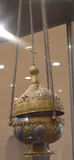 Censer
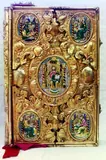 Gospel book
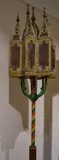 Processional candles