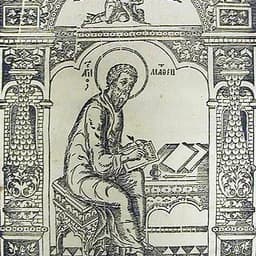
The Church confesses that the only-begotten Son of God, for us men and for our salvation, came down from heaven and was incarnate of the Holy Spirit and the Virgin Mary, and became man. He is one and the same Christ, perfect God and perfect man, in two natures united without confusion and without division, and the Virgin who bore Him is the Theotokos. Here the Fathers teach this faith in their own words.
33 passages from 9 Fathers, drawn from 11 works.
The Word Became Flesh
St. Athanasius the Great
On the Incarnation of the Word, § 17
And this was the wonderful thing that He was at once walking as man, and as the Word was quickening all things, and as the Son was dwelling with His Father. So that not even when the Virgin bore Him did He suffer any change, nor by being in the body was [His glory] dulled: but, on the contrary, He sanctified the body also. 6. For not even by being in the universe does He share in its nature, but all things, on the contrary, are quickened and sustained by Him. 7. For if the sun too, which was made by Him, and which we see, as it revolves in the heaven, is not defiled by touching the bodies upon earth, nor is it put out by darkness, but on the contrary itself illuminates and cleanses them also, much less was the all-holy Word of God, Maker and Lord also of the sun, defiled by being made known in the body; on the contrary, being incorruptible, He quickened and cleansed the body also, which was in itself mortal: “who did,” for so it says, “no sin, neither was guile found in His mouth.”
St. Cyril of Jerusalem
The Catechetical Lectures, Lecture XII: On the words Incarnate, and Made Man
Believe that He the Only-begotten Son of God—He Himself was again begotten of a Virgin. Believe the Evangelist John when he says, And the Word was made flesh, and dwelt among us. For the Word is eternal, Begotten of the Father Before All Worlds: but the flesh He took on Him recently for our sake.
St. Gregory the Theologian
Theological Oration III (On the Son)
He Who is now Man was once the Uncompounded. What He was He continued to be; what He was not He took to Himself. In the beginning He was, uncaused; for what is the Cause of God? But afterwards for a cause He was born. And that cause was that you might be saved, who insult Him and despise His Godhead, because of this, that He took upon Him your denser nature, having converse with Flesh by means of Mind. While His inferior Nature, the Humanity, became God, because it was united to God, and became One Person because the Higher Nature prevailed in order that I too might be made God so far as He is made Man.
St. John Chrysostom
Homilies on the Gospel of John, Homily XI (John 1:14)
So that when you hear that “the Word became Flesh,” be not disturbed nor cast down. For that Essence did not change to flesh, (it is impiety to imagine this,) but continuing what it is, It so took upon It the form of a servant.
[2.] Wherefore then does he use the expression, “was made”? To stop the mouths of the heretics. For since there are some who say that all the circumstances of the Dispensation were an appearance, a piece of acting, an allegory, at once to remove beforehand their blasphemy, he has put “was made”; desiring to show thereby not a change of substance, (away with the thought,) but the assumption of very flesh.
St. Augustine of Hippo
Tractates on the Gospel of John, Tractate XXIII (John 5:19–40)
But I was saying that Christ is the Word, and Christ is the Word of God, and Christ the Word is God; but Christ is not only the Word, since “the Word became flesh, and dwelt among us:” therefore Christ is both Word and flesh. For when “He was in the form of God, He thought it not robbery to be equal with God.” And what of us in our low estate, who, feeble and crawling on the ground, were not able to reach unto God, were we to be abandoned? God forbid. “He emptied Himself, taking upon Him the form of a servant;” not, therefore, by losing the form of God. He became man who was God, by receiving what He was not, not by losing what He was: so God became man. There thou hast something for thy weakness, something for thy perfection. Let Christ raise thee by that which is man, lead thee by that which is God-man, and guide thee through to that which is God.
St. Cyril of Alexandria
Commentary on the Gospel of Luke, Sermon V (Luke 2:40-52)
TO say that the child grew, and waxed strong in spirit, being filled with wisdom, and the grace of God was upon Him, must be taken as referring to His human nature. And examine, I pray you, closely the profoundness of the dispensation: the Word endures to be born in human fashion, although in His divine nature He has no beginning nor is subject to time: He Who as God is all perfect, submits to bodily growth: the Incorporeal has limbs that advance to the ripeness of manhood: He is filled with wisdom Who is Himself all wisdom. And what say we to this? Behold by these things Him Who was in the form of the Father made like unto us: the Rich in poverty: the High in humiliation: Him said to "receive," Whose is the fulness as God. So thoroughly did God the Word empty Himself! For what things are written of Him as a man shew the manner of the emptying.
Born of the Virgin
St. Ignatius of Antioch
The Epistle to the Ephesians, Chapter XIX
Now the virginity of Mary was hidden from the prince of this world, as was also her offspring, and the death of the Lord; three mysteries of renown, which were wrought in silence by God. How, then, was He manifested to the world? A star shone forth in heaven above all the other stars, the light of Which was inexpressible, while its novelty struck men with astonishment. And all the rest of the stars, with the sun and moon, formed a chorus to this star, and its light was exceedingly great above them all. And there was agitation felt as to whence this new spectacle came, so unlike to everything else [in the heavens]. Hence every kind of magic was destroyed, and every bond of wickedness disappeared; ignorance was removed, and the old kingdom abolished, God Himself being manifested in human form for the renewal of eternal life. And now that took a beginning which had been prepared by God. Henceforth all things were in a state of tumult, because He meditated the abolition of death.
St. Athanasius the Great
On the Incarnation of the Word, § 8
For He did not simply will to become embodied, or will merely to appear. For if He willed merely to appear, He was able to effect His divine appearance by some other and higher means as well. But He takes a body of our kind, and not merely so, but from a spotless and stainless virgin, knowing not a man, a body clean and in very truth pure from intercourse of men. For being Himself mighty, and Artificer of everything, He prepares the body in the Virgin as a temple unto Himself, and makes it His very own as an instrument, in it manifested, and in it dwelling.
St. Cyril of Jerusalem
The Catechetical Lectures, Lecture XII: On the words Incarnate, and Made Man
Is Eve then born out of a man’s side without a mother, and is a child not to be born without a father, of a virgin’s womb? This debt of gratitude was due to men from womankind: for Eve was begotten of Adam, and not conceived of a mother, but as it were brought forth of man alone. Mary, therefore, paid the debt, of gratitude, when not by man but of herself alone in an immaculate way she conceived of the Holy Ghost by the power of God.
St. Gregory the Theologian
Theological Oration III (On the Son)
He was born—but He had been begotten: He was born of a woman—but she was a Virgin. The first is human, the second Divine. In His Human nature He had no Father, but also in His Divine Nature no Mother. Both these belong to Godhead. He dwelt in the womb—but He was recognized by the Prophet, himself still in the womb, leaping before the Word, for Whose sake He came into being. He was wrapped in swaddling clothes—but He took off the swathing bands of the grave by His rising again. He was laid in a manger—but He was glorified by Angels, and proclaimed by a star, and worshipped by the Magi.
St. Gregory of Nyssa
As preserved in the Catena Aurea on Luke (on Luke 2:6–7)
Though coming in the form of man, yet not in every thing is He subject to the laws of man's nature; for while His being born of a woman, tells of human nature; virginity becoming capable of childbirth betokens something above man. Of Him then His mother's burden was light, the birth immaculate, the delivery without pain, the nativity without defilement, neither beginning from wanton desire, nor brought to pass with sorrow.
Homilies on the Gospel of Matthew, Homily IV (Matthew 1:17)
For that He did come forth of the Virgin’s flesh, He hath declared by speaking of “that which was conceived in her;” and Paul, by saying, “made of a woman;” whereby he stops the mouths of them that say, Christ came among us as through some conduit. For, if this were so, what need of the womb? If this were so, He hath nothing in common with us, but that flesh is of some other kind, and not of the mass which belongs to us. How then was He of the root of Jesse? How was He a rod? how Son of man? how was Mary His mother? how was He of David’s seed? how did he “take the form of a servant?” how “was the Word made flesh?” and how saith Paul to the Romans, “Of whom as concerning the flesh Christ came, who is God over all?” Therefore that He was of us, and of our substance, and of the Virgin’s womb, is manifest from these things, and from others beside; but how, is not also manifest.
One Christ, God and Man
St. Ignatius of Antioch
The Epistle to the Ephesians, Chapter VII
There is one Physician who is possessed both of flesh and spirit; both made and not made; God existing in flesh; true life in death; both of Mary and of God; first passible and then impassible, even Jesus Christ our Lord.
St. Athanasius the Great
On the Incarnation of the Word, § 18
Accordingly, when inspired writers on this matter speak of Him as eating and being born, understand that the body, as body, was born, and sustained with food corresponding to its nature, while God, the Word Himself, Who was united with the body, while ordering all things, also by the works He did in the body shewed Himself to be not man, but God the Word. But these things are said of Him, because the actual body which ate, was born, and suffered, belonged to none other but to the Lord: and because, having become man, it was proper for these things to be predicated of Him as man, to shew Him to have a body in truth, and not in seeming.
St. Cyril of Jerusalem
The Catechetical Lectures, Lecture IV: On the Ten Points of Doctrine
Believe then that this Only-begotten Son of God for our sins came down from heaven upon earth, and took upon Him this human nature of like passions with us, and was begotten of the Holy Virgin and of the Holy Ghost, and was made Man, not in seeming and mere show, but in truth; nor yet by passing through the Virgin as through a channel; but was of her made truly flesh, [and truly nourished with milk], and did truly eat as we do, and truly drink as we do. For if the Incarnation was a phantom, salvation is a phantom also. The Christ was of two natures, Man in what was seen, but God in what was not seen; as Man truly eating like us, for He had the like feeling of the flesh with us; but as God feeding the five thousand from five loaves; as Man truly dying, but as God raising him that had been dead four days; truly sleeping in the ship as Man, and walking upon the waters as God.
St. Gregory the Theologian
Theological Oration III (On the Son)
To give you the explanation in one sentence. What is lofty you are to apply to the Godhead, and to that Nature in Him which is superior to sufferings and incorporeal; but all that is lowly to the composite condition of Him who for your sakes made Himself of no reputation and was Incarnate—yes, for it is no worse thing to say, was made Man, and afterwards was also exalted. The result will be that you will abandon these carnal and grovelling doctrines, and learn to be more sublime, and to ascend with His Godhead, and you will not remain permanently among the things of sight, but will rise up with Him into the world of thought, and come to know which passages refer to His Nature, and which to His assumption of Human Nature.
St. Augustine of Hippo
Tractates on the Gospel of John, Tractate XIX (John 5:19–30)
But the same who is Son of God is also Son of man. For by adhering to the unity of person, the Son of man with the Son of God is made one person, and the Son of God is the same person which the Son of man is. But what characteristic it has, and wherefore, must be distinguished. The Son of man has soul and body. The Son of God, which is the Word of God, has man, as the soul has body. And just as soul having body does not make two persons, but one man; so the Word, having man, maketh not two persons, but one Christ. What is man? A rational soul, having a body. What is Christ? The Word of God, having man.
St. Cyril of Alexandria
Commentary on the Gospel of Luke, Sermon LXIII (Luke 10:16)
We believe that the Word, though He was God, became flesh, that is, man; and not that He joined some man unto Him in equal honour: for this some venture to say and think, so that the Word from God the Father is to be regarded by us as one Son by Himself; and He Who sprang from the holy virgin as another beside Him, separately and by Himself: for such are the impure inventions of these men. We however agree with the divine Paul, who says: "There is one Lord; one faith; one baptism:" for we divide not Him Who is indivisible, but confess one Christ, the Word, Who is from God the Father, Who was made man, and incarnate, Whom the heavens worship, and the angels honour: and we too with them praise Him, crowning Him with divine honour, not so much as a man Who was made God, but as God Who became man.
Commentary on the Gospel of Luke, Sermon I (Luke 1:1-2:7)
The natures, however, which combined unto this real union were different, but from the two together is one God the Son, without the diversity of the natures being destroyed by the union. For a union of two natures was made, and therefore we confess One Christ, One Son, One Lord. And it is with reference to this notion of a union without confusion that we proclaim the holy Virgin to be the mother of God, because God the Word was made flesh and became man, and by the act of conception united to Himself the temple that He received from her. For we perceive that two natures, by an inseparable union, met together in Him without confusion, and indivisibly. For the flesh is flesh, and not deity, even though it became the flesh of God: and in like manner also the Word is God, and not flesh, though for the dispensation's sake He made the flesh His own. But although the natures which concurred in forming the union are both different and unequal to one another, yet He Who is formed from them both is only One: nor may we separate the One Lord Jesus Christ into man severally and God severally, but we affirm that Christ Jesus is One and the Same, acknowledging the distinction of the natures, and preserving them free from confusion with one another.
Why God Became Man
St. Athanasius the Great
On the Incarnation of the Word, § 13
What then was God to do? or what was to be done save the renewing of that which was in God’s image, so that by it men might once more be able to know Him? But how could this have come to pass save by the presence of the very Image of God, our Lord Jesus Christ? For by men’s means it was impossible, since they are but made after an image; nor by angels either, for not even they are (God’s) images. Whence the Word of God came in His own person, that, as He was the Image of the Father, He might be able to create afresh the man after the image. 8. But, again, it could not else have taken place had not death and corruption been done away. 9. Whence He took, in natural fitness, a mortal body, that while death might in it be once for all done away, men made after His Image might once more be renewed. None other then was sufficient for this need, save the Image of the Father.
St. Cyril of Jerusalem
The Catechetical Lectures, Lecture XII: On the words Incarnate, and Made Man
Men forsook God, and made carved images of men. Since therefore an image of man was falsely worshipped as God, God became truly Man, that the falsehood might be done away. The Devil had used the flesh as an instrument against us; and Paul knowing this, saith, But I see another law in my members warring against the law of my mind, and bringing me into captivity, and the rest. By the very same weapons, therefore, wherewith the Devil used to vanquish us, have we been saved. The Lord took on Him from us our likeness, that He might save man’s nature: He took our likeness, that He might give greater grace to that which lacked; that sinful humanity might become partaker of God. For where sin abounded, grace did much more abound.
St. Gregory the Theologian
Theological Oration IV (Which is the Second Concerning the Son)
So He is called Man, not only that through His Body He may be apprehended by embodied creatures, whereas otherwise this would be impossible because of His incomprehensible nature; but also that by Himself He may sanctify humanity, and be as it were a leaven to the whole lump; and by uniting to Himself that which was condemned may release it from all condemnation, becoming for all men all things that we are, except sin;—body, soul, mind and all through which death reaches—and thus He became Man, who is the combination of all these; God in visible form, because He retained that which is perceived by mind alone. He is Son of Man, both on account of Adam, and of the Virgin from Whom He came; from the one as a forefather, from the other as His Mother, both in accordance with the law of generation, and apart from it.
St. Gregory of Nyssa
The Great Catechism, Chapter XV
You ask the reason why God was born among men. If you take away from life the benefits that come to us from God, you would not be able to tell me what means you have of arriving at any knowledge of Deity. In the kindly treatment of us we recognize the benefactor; that is, from observation of that which happens to us, we conjecture the disposition of the person who operates it. If, then, love of man be a special characteristic of the Divine nature, here is the reason for which you are in search, here is the cause of the presence of God among men. Our diseased nature needed a healer. Man in his fall needed one to set him upright. He who had lost the gift of life stood in need of a life-giver, and he who had dropped away from his fellowship with good wanted one who would lead him back to good.
He who was shut up in darkness longed for the presence of the light. The captive sought for a ransomer, the fettered prisoner for some one to take his part, and for a deliverer he who was held in the bondage of slavery.
St. Augustine of Hippo
Tractates on the Gospel of John, Tractate II (John 1:6–14)
But because “the Word was made flesh, and dwelt among us,” by His very nativity he made an eye-salve to cleanse the eyes of our heart, and to enable us to see His majesty by means of His humility. Therefore “the Word was made flesh, and dwelt among us:” He healed our eyes; and what follows? “And we beheld His glory.” His glory can no one see unless healed by the humility of His flesh. Wherefore were we not able to see? Consider, then, dearly beloved, and see what I say. There had dashed into man’s eye, as it were, dust, earth; it had wounded the eye, and it could not see the light: that wounded eye is anointed; by earth it was wounded, and earth is applied to it for healing. For all eye-salves and medicines are derived from the earth alone. By dust thou wert blinded, and by dust thou art healed: flesh, then, had wounded thee, flesh heals thee. The soul had become carnal by consenting to the affections of the flesh; thus had the eye of the heart been blinded. “The Word was made flesh:” that Physician made for thee an eye-salve.
St. Cyril of Alexandria
Commentary on the Gospel of Luke, Sermon CXLII (Luke 22:17-22)
In what manner therefore can man upon earth, clothed as he is with mortality, return to incorruption? I answer, that this dying flesh must be made partaker of the life-giving power which comes from God. But the life-giving power of God the Father is the Only-begotten Word: and Him He sent to us as a Saviour and Deliverer. And how He sent Him, the blessed John the Evangelist clearly tells us, saying, "And the Word became flesh, and dwelt in us." But He became flesh, not by having undergone any change or alteration into what He had not been, nor again by having ceased to be the Word; — for He knows not what it is to suffer the shadow of a change; — but rather by having been born in the flesh of a woman, and taken to Himself that body which He received from her, in order that, having implanted Himself in us by an inseparable union, He might raise us above the power both of death and corruption.
That We Might Be Made God
St. Athanasius the Great
On the Incarnation of the Word, § 54
For He was made man that we might be made God; and He manifested Himself by a body that we might receive the idea of the unseen Father; and He endured the insolence of men that we might inherit immortality. For while He Himself was in no way injured, being impassible and incorruptible and very Word and God, men who were suffering, and for whose sakes He endured all this, He maintained and preserved in His own impassibility.
St. John Chrysostom
Homilies on the Gospel of John, Homily XI (John 1:14)
Having declared that they who received Him were “born of God,” and had become “sons of God,” he adds the cause and reason of this unspeakable honor. It is that “the Word became Flesh,” that the Master took on Him the form of a servant. For He became Son of man, who was God’s own Son, in order that He might make the sons of men to be children of God. For the high when it associates with the low touches not at all its own honor, while it raises up the other from its excessive lowness; and even thus it was with the Lord. He in nothing diminished His own Nature by this condescension, but raised us, who had always sat in disgrace and darkness, to glory unspeakable.
Homilies on the Gospel of John, Homily XI (John 1:14)
What then was the tabernacle in which He dwelt? Hear the Prophet say; “I will raise up the tabernacle of David that is fallen.” (Amos ix. 11.) It was fallen indeed, our nature had fallen an incurable fall, and needed only that mighty Hand. There was no possibility of raising it again, had not He who fashioned it at first stretched forth to it His Hand, and stamped it anew with His Image, by the regeneration of water and the Spirit. And observe I pray you, the awful and ineffable nature of the mystery. He inhabits this tabernacle for ever, for He clothed Himself with our flesh, not as again to leave it, but always to have it with Him. Had not this been the case, He would not have deemed it worthy of the royal throne, nor would He while wearing it have been worshiped by all the host of heaven, angels, archangels, thrones, principalities, dominions, powers. What word, what thought can represent such great honor done to our race, so truly marvelous and awful?
St. Augustine of Hippo
Tractates on the Gospel of John, Tractate II (John 1:6–14)
But that men might be born of God, God was first born of them. For Christ is God, and Christ was born of men. It was only a mother, indeed, that He sought upon earth; because He had already a Father in heaven: He by whom we were to be created was born of God, and He by whom we were to be re-created was born of a woman. Marvel not, then, O man, that thou art made a son by grace, that thou art born of God according to His Word. The Word Himself first chose to be born of man, that thou mightest be born of God unto salvation, and say to thyself, Not without reason did God wish to be born of man, but because He counted me of some importance, that He might make me immortal, and for me be born as a mortal man.
Theophylact of Ohrid
Explanation of the Gospel of John (on John 6:35–56), as preserved in the Catena Aurea on John, trans. J. H. Newman, 1841
For we do not eat God simply, God being impalpable and incorporeal; nor again, the flesh of man simply, which would not profit us. But God having taken flesh into union with Himself; that flesh is quickening. Not that it has changed its own for the Divine nature; but, just as heated iron remains iron, with the action of the heat in it; so our Lord's flesh is quickening, as being the flesh of the Word of God.
The Catechetical Lectures, Lecture XII: On the words Incarnate, and Made Man
Through Eve yet virgin came death; through a virgin, or rather from a virgin, must the Life appear: that as the serpent beguiled the one, so to the other Gabriel might bring good tidings.
The Incarnation Foretold and Prefigured
St. John Chrysostom
Homilies on the Gospel of Matthew, Homily V (Matthew 1:22, 23)
“Behold, a virgin shall be with child, and shall bring forth a son, and they shall call His name Emmanuel.”
How was it then, one may say, that His name was not called Emmanuel, but Jesus Christ? Because he said not, “thou shalt call,” but “they shall call,” that is, the multitude, and the issue of events. For here he puts the event as a name: and this is customary in Scripture, to substitute the events that take place for names.
Therefore, to say, “they shall call” Him “Emmanuel,” means nothing else than that they shall see God amongst men. For He hath indeed always been amongst men, but never so manifestly.
St. Cyril of Alexandria
Commentary on the Gospel of Luke, Sermon I (Luke 1:1-2:7)
But in answer to those who argue that, if He were brought forth in the flesh, the Virgin was corrupted: and if she were not corrupted, that He was brought forth only in appearance, we say; the prophet declares, "the Lord, the God of Israel, hath entered in and gone out, and the gate remaineth closed." If, moreover, the Word was made flesh without sexual intercourse, being conceived altogether without seed, then was He born without injury to her virginity.