The feasts of the year · 21 November
The Entry of the Theotokos into the Temple
Hyrja e Hyjlindëses në Tempull
The Entry of the Theotokos into the Temple, kept on 21 November, is the second great feast of the Mother of God. Like her Nativity, it rests on no biblical or historical account: it comes from the Church's tradition and from the service of the feast. The service tells how Mary, then a very small girl, was brought by her parents to the Temple in Jerusalem, to be raised among the virgins dedicated to the service of God until their betrothal. The Temple community, headed by the priest Zacharias, the father of John the Baptist, received her solemnly. She was brought into the holy place to be fed there by angels and to become herself the holy of holies of God, the living temple of the Child to be born of her. The service sings much of Psalm 44, which the Church reads as a prophecy of Mary. At Vespers three Old Testament lessons, from Exodus, Kings and Ezekiel, each end with the glory of the Lord filling the house of the Lord. The feast falls within the forty-day fast before the Nativity, and from this day the Church begins to sing the hymns of the Nativity.
The icon, explained
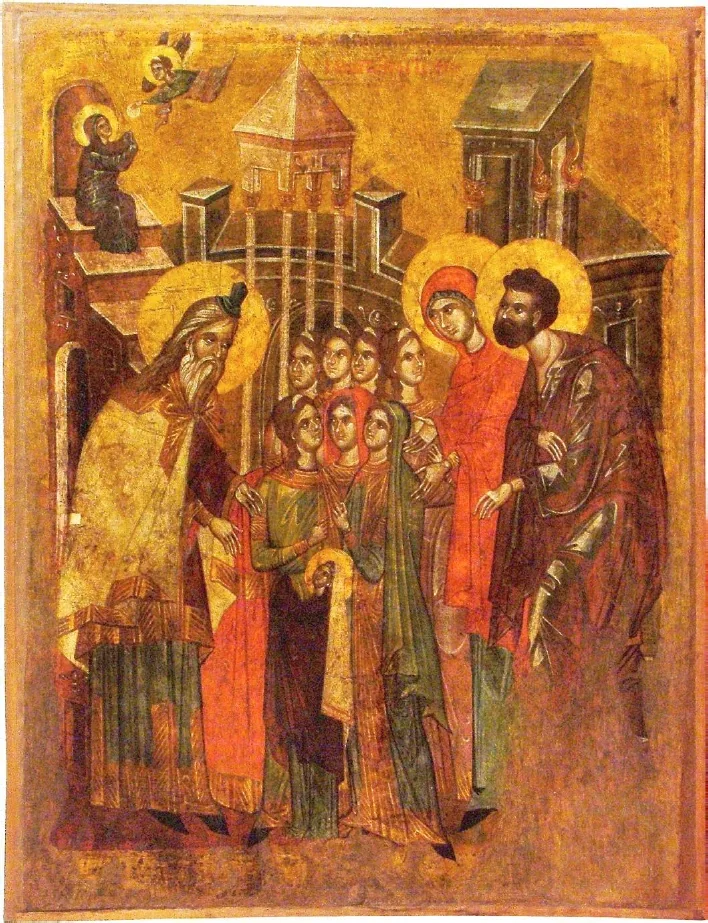
Choose a number on the icon, or a name in the list, to see what is painted there and what it means.
How the painters' Guide of Mount Athos describes it
«The temple. A staircase leading up to the porch. The prophet Zacharias stands at the gate, clothed in pontifical robes. He throws his arms open. The Holy Virgin, three years old, mounts the steps before him. She holds out one hand and carries a taper in the other; Joachim and Anna, behind, point her out to a crowd of virgins carrying tapers, who stand near.»The Byzantine Guide to Painting, tr. M. Stokes, in Didron, Christian Iconography II (1886), p. 348
«The temple is crowned by a magnificent cupola. The Virgin is seated beneath the centre of the dome; she takes the bread offered to her with a benediction by the archangel Gabriel.»The Byzantine Guide to Painting, tr. M. Stokes, in Didron, Christian Iconography II (1886), p. 348
The readings
- Vespers
- Vespers
- Vespers
- Vespers
- Vespers
- Vespers
- Vespers
- Vespers
- Vespers
- Orthros
- Orthros
- Epistle
- Gospel
- Gospel
The hymns of the feast
To-day is the foreshadowing of the beneficence of God which is to come, and the heralding of man's salvation. The Virgin is clearly manifested in the temple of God, and in anticipation announceth Christ unto all men. Unto her let us, also, cry aloud: Hail, thou who art the fulfilment of the Creator's providence!Sot është parënisja e mirëpëlqimit të Perëndisë dhe parëlëçitja e shpëtimit të njerëzve; në Tempullin e Perëndisë shfaqet Virgjëresha, edhe Krishtin u paralajmëron të gjithëve. Prandaj me gëzim le t’i këndojmë asaj: Gëzohu o Përmbushja Hyjnore e planit të Krijuesit
The all-pure Temple of the Saviour, the most precious Bridal-chamber and Virgin, the Treasure-house of the glory of God, to-day is led into the temple of the Lord, bringing with her the grace which is in the Spirit Divine; whom also the Angels of God do celebrate in song: This is the Abode of Heaven.I përmbipaqmi Tempull i Shpëtimtarit, e përmbishenjta Nusërore e Virgjër dhe Thesari i Shenjtë i Lavdisë së Perëndisë, sot po sillet me lavdi, në shtëpinë e Zotit dhe hirin brenda po na sjell, plot me Frymën e Shenjtë dhe engjëjt e Perëndisë po e lavdërojnë: Me të vërtetë kjo grua është Banesa e Qiellshme
What the Church says of it
«Like the feast of her Nativity, this feast too has no biblical or historical reference. But, like her Nativity, this feast is full of significant spiritual meaning for the believing Christian.»«Hyrja e Hylindëses në Tempull», the Church of Albania · translated by this site
«She was brought into the holy place to be “fed” there by the angels, so that she herself might become the “holy of holies” of God, the living sanctuary and temple of the divine Child who would be born of her.»«Hyrja e Hylindëses në Tempull», the Church of Albania · translated by this site
«The central theme of the feast of the Entry of Mary into the Temple, repeated many times in the liturgical services, is the fact that she enters the Temple to become herself the living temple of God, thus inaugurating the New Covenant, in which the prophecies of the Old have been fulfilled, that “the dwelling of God is within man” and that the human person is a fitting dwelling place for the Divine Presence»«Hyrja e Hylindëses në Tempull», the Church of Albania · translated by this site
«Thus the Entry of the Theotokos into the Temple is the feast that celebrates the end of the physical Temple in Jerusalem as the dwelling place of God. When little Mary entered the Temple, the time of the Temple came to an end, and “the foreshadowing of the beneficence of God” was shown. On this feast we celebrate, in the person of the Mother of Christ, what we ourselves also are: the house and the tabernacle of the Lord.»«Hyrja e Hylindëses në Tempull», the Church of Albania · translated by this site
Read more on the site
- The Visitation of Mary to Elizabeth · the Gospel with the Fathers
- The Magnificat · the Gospel with the Fathers
- The Theotokos · a topic