The feasts of the year · 15 August
The Dormition of the Theotokos
Fjetja e Hyjlindëses
The Dormition, the falling-asleep, of the Theotokos is kept on 15 August, after two weeks of fasting. The feast is also called «the Taking» («Marrja»): it remembers the death, the rising and the glorification of the Mother of Christ, and proclaims that God took Mary into the heavenly kingdom of Christ, in the fulness of her bodily and spiritual life. Scripture and history give no account of it, as they give none of her Nativity or her Entry into the Temple. The Church's Tradition says that Mary died as all people die: not of her own will, as her Son did, but because human nature is mortal. The Church teaches that she had no personal sins, yet she too needed to be saved by Christ; after she died, her Son raised her as the Mother of Life, and she now shares the eternal life of Paradise. The hymns sing that the Source of life is laid in the grave, and that the tomb and death could not hold her. The Old Testament readings and the Gospels of Matins and the Liturgy are those of her Nativity and her Entry into the Temple. Some churches bless flowers on the feast.
The icon, explained
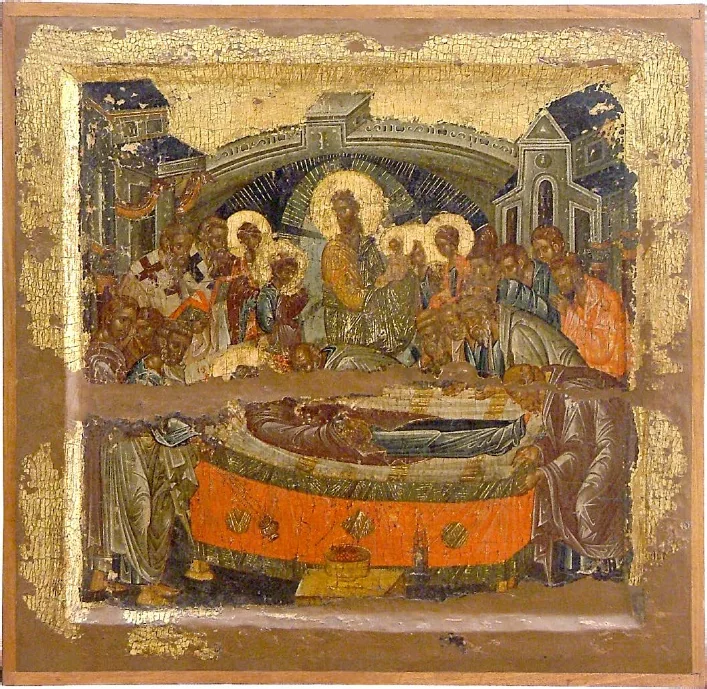
Choose a number on the icon, or a name in the list, to see what is painted there and what it means.
How the painters' Guide of Mount Athos describes it
«A house. The Holy Virgin within lies dead upon a couch, her arms crossed upon her breast, torches and lighted tapers at each side of the bed. Beside the bed stands an angel with a naked sword, and a Hebrew, whose hands are cut off and fastened to the bed. St. Peter incenses the feet of the Holy Virgin with a censer. At her head stand St. Paul and St. John Theologos, who kisses her. Other apostles and bishops stand round. Dionysius the Areopagite, Hierotheus and Timotheus holding the gospels. Women in tears. Christ is above, holding in His arms the soul of the Blessed Virgin, clad in white. She is surrounded by a great light and a crowd of angels.»The Byzantine Guide to Painting, tr. M. Stokes, in Didron, Christian Iconography II (1886), p. 349
The readings
- Vespers
- Vespers
- Vespers
- Vespers
- Orthros
- Orthros
- Epistle
- Gospel
- Gospel
The hymns of the feast
In Birth-giving thou didst preserve thy virginity; in thy Falling-asleep thou hast not forsaken the world, O Birth-giver of God. Thou hast passed over into life, thou who art the Mother of Life, and through thine intercessions dost deliver our souls from death.Në lindjen tënde virgjërinë e ruajte, në fjetjen tënde s’e harrove botën, o Hyjlindëse. Në jetën e qiellit shkove, o Nënë e Jetës, me lutjet tuaja çliro shpirtet tona prej vdekjes
The tomb and death have not been able to hold the Birth-giver of God, who is constant in supplications, in intercession an unfailing hope: for the Mother of the Life is come into the presence of the Life, who took up his abode in her ever-Virgin womb.Zonjën që është e pafjetur për ndërmjetime dhe shpresën tonë të patundur për çdo mbrojtje, varri dhe vdekja s’e zotëruan dot, se ishte Nëna e Jetës dhe përsëri në jetë e çoi, ai që banoi në gjirin e saj të virgjër
What the Church says of it
«It proclaims that Mary was “taken” by God into the heavenly kingdom of Christ, in the fulfilment of her bodily and spiritual existence.»«Fjetja e Hyjlindëses», the Church of Albania · translated by this site
«The Tradition of the Church says that Mary died as all people die, not “voluntarily”, as her Son did, but as a consequence of mortal human nature, which is invisibly bound up with the corruption of this world.»«Fjetja e Hyjlindëses», the Church of Albania · translated by this site
«The Orthodox Church teaches us that Mary has no personal sins. Nevertheless, in the Gospel of the feast, in the liturgical services and in the icon of the Dormition, the Church proclaims that Mary truly needed to be saved by Christ, just as all people have been saved from the pains, the sufferings and the death of this world; and that, after she died, she was raised by her Son as the Mother of Life, and that she now shares in the eternal life of Paradise, which has been prepared for and promised to all those who “hear the word of God, and keep it”»«Fjetja e Hyjlindëses», the Church of Albania · translated by this site
«Thus the feast of the Dormition of the Theotokos is the celebration of the fact that all people have been “exalted” into the blessedness of the victorious Christ, and that this exaltation has already been accomplished in Mary the Theotokos.»«Fjetja e Hyjlindëses», the Church of Albania · translated by this site
Read more on the site
- The Visitation of Mary to Elizabeth · the Gospel with the Fathers
- The Magnificat · the Gospel with the Fathers
- The Theotokos · a topic
- Life after Death · a topic