The feasts of the year · 6 January
Theophany
Theofania, Pagëzimi i Zotit
Theophany, kept on 6 January, celebrates the baptism of Christ by John in the river Jordan. Its name means “the manifestation of God”, and it is also called Epiphany, “the manifestation from above”. At first it was a single feast of God's appearing in the world in human form: the Nativity, the worship of the Magi, the events of Christ's childhood and his baptism. Its stress is on Jesus shown as the Messiah of Israel and the divine Son of God, one of the Holy Trinity: at his baptism the voice of the Father bears witness to him and the Spirit appears in the form of a dove. Its services are ordered like those of the Nativity, with the Royal Hours and the Liturgy of St Basil joined to Vespers on the eve, which is kept as a strict fast. The chief mark of the feast is the Great Blessing of the Water, served on the eve and again on the day, often out of doors where water flows. The celebrant plunges the cross into the water three times and blesses the people and their homes with it. On the next day the Church honours John the Baptist.
The icon, explained
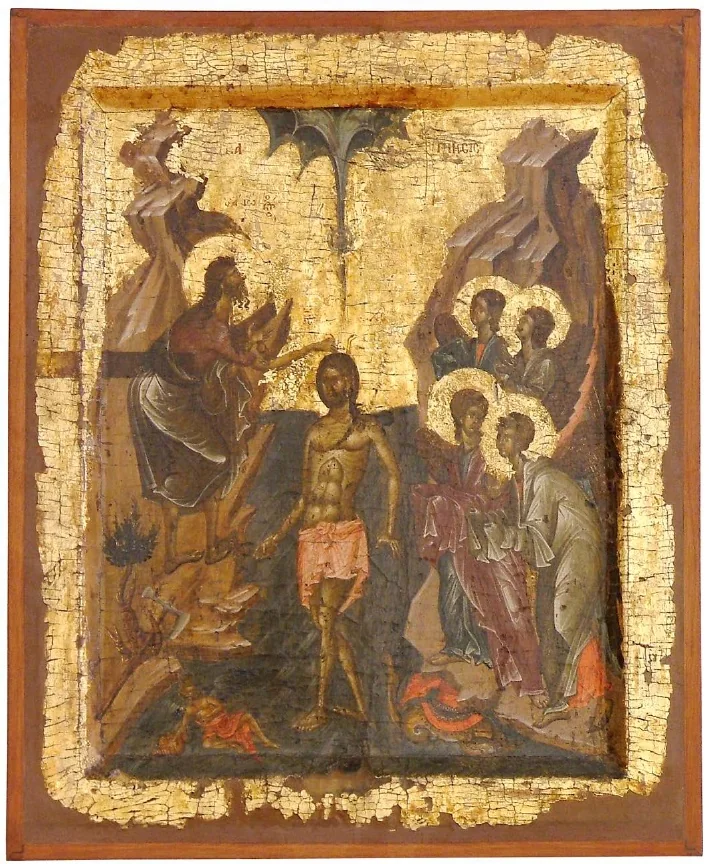
Choose a number on the icon, or a name in the list, to see what is painted there and what it means.
How the painters' Guide of Mount Athos describes it
«Christ standing naked in the midst of the Jordan. The Harbinger, on the river bank to the right of Christ, looks upward; his right hand rests upon the head of Christ, he raises the left towards heaven. Above, the sky is seen, whence issues the Holy Spirit, descending on a ray which rests upon the head of Christ. In the midst of the ray we read the words: "This is My beloved Son, in whom I am well pleased." On the left angels stand in reverence with arms outspread. Clothes lie on the ground. Below the Harbinger, and across the Jordan, a naked man reclines, who looks behind him at Christ, as if in terror. He holds a vase whence he pours water. Fish surround Christ.»The Byzantine Guide to Painting, tr. M. Stokes, in Didron, Christian Iconography II (1886), p. 302
The readings
- Orthros
- Epistle
- Epistle
- Gospel
The hymns of the feast
When in Jordan thou wast baptized, O Lord, the worship of the Trinity was made manifest. For the voice of the Father bare witness unto thee, calling thee his beloved Son, and the Spirit, in the form of a dove, confirmed the steadfastness of that word. O Christ our God, who didst manifest thyself, and dost enlighten the world, glory to thee.Kur pagëzoheshe në Jordanin, o Zot, për ne, ahere falja e Trinisë së Shenjtë kudo u shfaq, se zëri i Atit po na dëshmonte për Ty faqeza dhe Bir të dashur të tij po të quante, edhe Shpirti i Shenjtë si një pëllumb, vërtetonte çdo fjalë me siguri. O Krisht Perëndi, që u shfaqe dhe ndriçove botën, lavdi më Ty!
To-day hast thou revealed thyself unto the universe, and thy Light, O Lord, hath showed a sign unto us, who with understanding sing unto thee: Thou art come, and hast revealed thyself, O Light Unapproachable.U Shfaqe me lavdi, në tërë botën, edhe Drita Jote ndriçoi mbi ne sot, pra, të himnojmë me kuptim: Erdhe dhe zbulove vetveten, O Dritë e Paafruarshme
What the Church says of it
«Thus, in his baptism by John in the Jordan, Jesus identified himself with sinners, as “the Lamb ... which taketh away the sin of the world” (John 1:29), the “Beloved” of the Father, whose messianic task is to free people from their sins (Luke 3:21; Mark 1:35). And he was revealed as One of the Holy Trinity, attested by the voice of the Father and by the Spirit in the form of a dove.»«Uji i Bekuar (Epifania)», the Church of Albania · translated by this site
«Christians believe that ever since the Son of God took human flesh and was immersed in the waters of the Jordan, all matter has been sanctified and cleansed in him, washed of its qualities that had to do with death, inherited from the evil one and from the weakness and wickedness of people.»«Uji i Bekuar (Epifania)», the Church of Albania · translated by this site
«Then he blesses the people and their homes with the sanctified water, which stands for the salvation of all mankind and of all creation, which Christ has touched through his “epiphany” in the flesh, for the life of the world.»«Uji i Bekuar (Epifania)», the Church of Albania · translated by this site
«Thus the sanctification and the sprinkling of the water of Epiphany is not a pagan ritual. Rather, it is the expression of the most central fact of the Christian vision of man, and of his life and his world. This is the liturgical witness which shows us that the vocation and destiny of creation is to be “filled with all the fulness of God” (Ephesians 3:19).»«Uji i Bekuar (Epifania)», the Church of Albania · translated by this site
Read more on the site
- The Baptism of Jesus · the Gospel with the Fathers
- The Preaching of John the Baptist · the Gospel with the Fathers
- Behold the Lamb of God: John's Witness · the Gospel with the Fathers
- Baptism · a topic
- The Holy Trinity · a topic