The feasts of the year · 25 March
The Annunciation
Ungjillëzimi i Hyjlindëses
The Annunciation, kept on 25 March, nine months before Christmas, celebrates the announcement to the Virgin Mary that she would bear Christ. Saint Luke tells it: in the sixth month the angel Gabriel was sent from God to Nazareth, to a virgin betrothed to Joseph. He greeted her, “Hail, thou that art full of grace, the Lord is with thee,” and told her that she would conceive and bear a son, Jesus, who would be called the Son of the Most High and whose kingdom would have no end. When Mary asked how this could be, he answered that the Holy Spirit would come upon her and the power of the Most High would overshadow her. Mary answered: “Behold the handmaid of the Lord; be it unto me according to thy word.” The feast's hymn calls this day the beginning of our salvation, when the Son of God becomes the Son of the Virgin. The feast normally falls in Great Lent. On a Lenten weekday its Divine Liturgy is served in the evening with Vespers, after a day of full fasting, and it is the only Liturgy of Saint John Chrysostom allowed on a weekday of the Fast.
The icon, explained
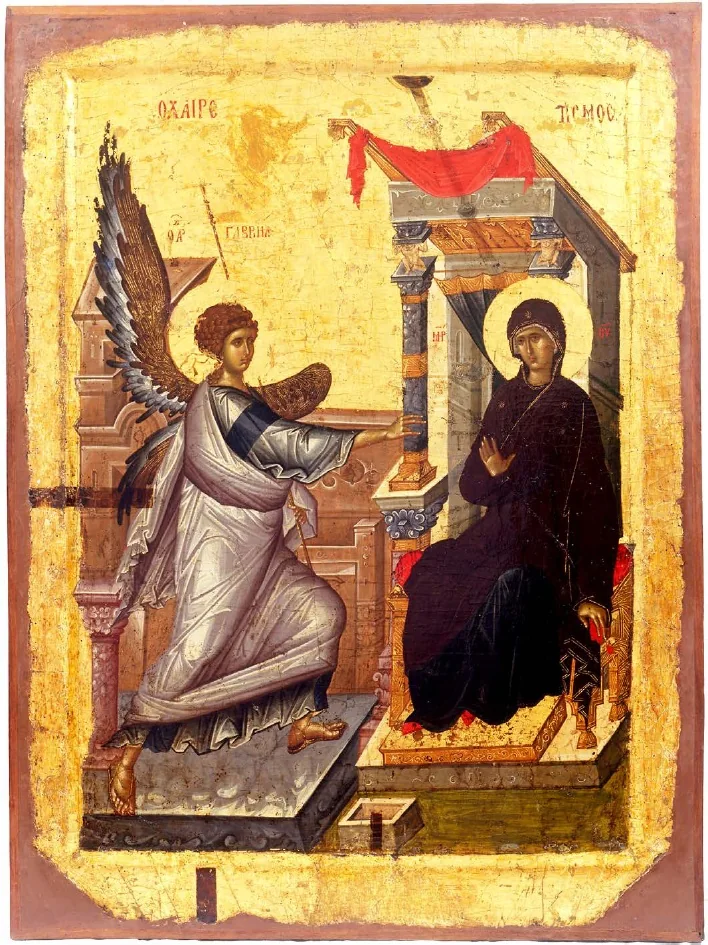
Choose a number on the icon, or a name in the list, to see what is painted there and what it means.
How the painters' Guide of Mount Athos describes it
«Houses. The Holy Virgin standing before a seat, her head a little bent. In her left hand she holds a spindle with silk rolled on it; her right hand is stretched out open towards the Archangel. St. Michael is before her; he salutes her with the right hand, and holds a bâton (long as a lance) in his left. The sky above the house. The Holy Spirit descends from it upon a ray which reaches to the Virgin's head.»The Byzantine Guide to Painting, tr. M. Stokes, in Didron, Christian Iconography II (1886), p. 299
The readings
- Orthros
- Orthros
- Epistle
- Gospel
The hymns of the feast
To-day is the crown of our salvation, and the manifestation of that mystery which is from everlasting: The Son of God becometh the son of a Virgin, and Gabriel announceth the glad tidings of grace. Wherefore let us also cry aloud with him unto the Birth-giver of God: Hail, thou that art full of grace, the Lord is with theeSot është nisja e shpëtimit tonë dhe shfaqja e misterit të përjetshëm; i Biri i Perëndisë bëhet i Biri i Virgjëreshës dhe Gabrieli ungjillëzon këtë gëzim. Prandaj, le t’i thërrasim Hyjlindëses: Gëzohu o Hirplote, Zoti është me ty
«Ungjillëzimi i Hyjlindëses Mari (Vangjelizmoi).», the Church of Albania
What the Church says of it
«The services of the feast of the Annunciation, Orthros and the Divine Liturgy, stress again and again the glad tidings of the salvation of mankind in the birth of the Saviour.»«Ungjillëzimi i Hyjlindëses Mari (Vangjelizmoi).», the Church of Albania · translated by this site
«A special feature of this feast is the canon of Orthros, which has the character of a dialogue between the Archangel Gabriel and the Virgin Mary. Also, among the most popular elements of the feast is the megalynarion, which takes the form of our greeting to the virgin mother in the words of the Archangel: With the voice of the archangel let us cry unto thee, O pure Virgin: Hail, thou that art full of grace, the Lord is with thee!»«Ungjillëzimi i Hyjlindëses Mari (Vangjelizmoi).», the Church of Albania · translated by this site
«Therefore, the celebration of the Annunciation is the feast of our receiving the glad tidings of salvation, and of our glorification of Mary, the handmaid of God, who became the Mother of God in the flesh.»«Ungjillëzimi i Hyjlindëses Mari (Vangjelizmoi).», the Church of Albania · translated by this site
Read more on the site
- The Annunciation to the Virgin Mary · the Gospel with the Fathers
- The Visitation of Mary to Elizabeth · the Gospel with the Fathers
- The Magnificat · the Gospel with the Fathers
- The Incarnation · a topic
- The Theotokos · a topic