The feasts of the year · 8 September
The Nativity of the Theotokos
Lindja e Hyjlindëses
The Church keeps the birth of the Virgin Mary on 8 September. Besides the Annunciation, three great feasts honour her, and this is the first of them; it is also the first of the Twelve Great Feasts in a Church year that begins on 1 September. Scripture does not tell of Mary's birth. The story comes from apocryphal writings that are not part of the New Testament, and the feast's hymns keep the tradition: Joachim and Anna, a devout Jewish couple among the small remnant of the faithful who awaited the promised Messiah, were old and childless and prayed constantly for a child. In answer they were blessed with a child who would become the Mother of Christ. The feast praises Mary's birth, Mary herself and her righteous parents, and the Church sees in it the first preparation for the salvation of the world. At Vespers three Old Testament readings are read of her: Jacob's ladder, the shut eastern gate of Ezekiel's temple, and the house that Wisdom built. The feast's hymns are sung on days before and after it, and on the next day the Church honours Joachim and Anna.
The icon, explained
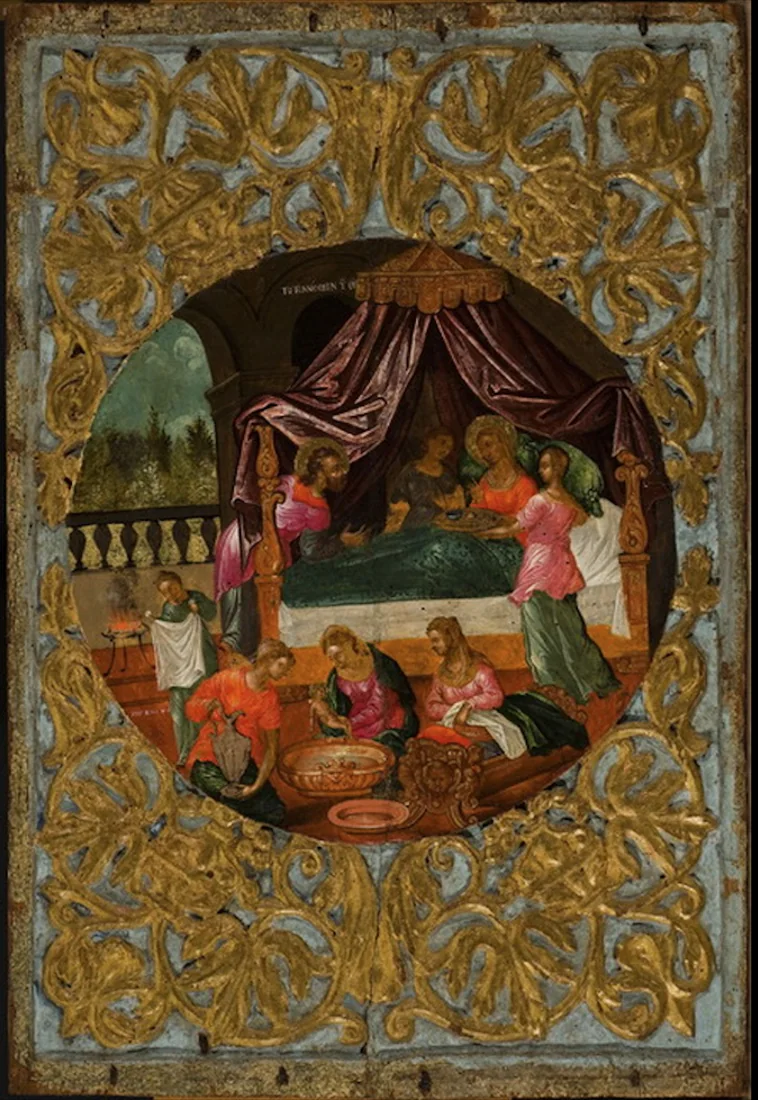
Choose a number on the icon, or a name in the list, to see what is painted there and what it means.
How the painters' Guide of Mount Athos describes it
«Houses. St. Anna lying on a bed under a coverlet, her head resting on a pillow. Two attendants support her from behind, another stirs the air with a fan. Other women, carrying dishes, pass out by the door. Under them are others, seated, who wash the infant in a basin. Another, again, rocks the infant in the cradle.»The Byzantine Guide to Painting, tr. M. Stokes, in Didron, Christian Iconography II (1886), p. 348
«Two scenes or acts are comprised under this heading, the washing and the rocking to sleep.»The Byzantine Guide to Painting, tr. M. Stokes, in Didron, Christian Iconography II (1886), p. 348
The readings
- Vespers
- Vespers
- Vespers
- Vespers
- Orthros
- Orthros
- Epistle
- Gospel
- Gospel
The hymns of the feast
Thy holy Nativity, O virgin Birth-giver of God, hath proclaimed joy unto all the universe; for from thee is risen the Sun of Righteousness, even Christ our God. And having destroyed the curse, he hath bestowed a blessing; and having brought Death to naught, he hath given unto us life eternal.Lindja jote, o Hyjlindëse, gëzoi e ndriti tërë gjithësinë, se prej teje shkëlqeu Dielli i Drejtësisë, Krishti Perëndia ynë, që zgjidhi mallkimin dhe na dha bekimin, duke e prishur vdekjen dhe duke na dhënw jetën e amëshuar
Joachim and Anna were delivered from the reproach of childlessness, and Adam and Eve from the corruption of death, in thy holy Nativity, O All-pure One. This do thy people celebrate, being redeemed from the guilt of transgressions, when they cry unto thee: The barren giveth birth to the Birth-giver of God and the Nourisher of our Life.Me lindjen tënde, o virgjëreshë e pastër, Joakimi dhe Ana u çliruan prej shterpësisë dhe Adami dhe Eva prej prishjes së vdekjes. Dhe ne, populli yt, të çliruar prej mëkatit, të kremtojmë dhe të këndojmë: Ajo që ishte shterpë lindi Hyjlindësen, Ushqyesen e Jetës sonë
What the Church says of it
«The fact that there is no biblical statement about the birth of Mary is of little importance for the meaning of the feast. Even if the factual basis of the event, as it is celebrated in the Church, were historically debatable, its divine meaning “for us men and for our salvation” is more than clear.»«Lindja e Hyjlindëses Mari», the Church of Albania · translated by this site
«There had to be someone born of human flesh and blood who would be spiritually fit to become the Mother of Christ, and she herself had to be born of persons who would be spiritually fit to be her parents.»«Lindja e Hyjlindëses Mari», the Church of Albania · translated by this site
«Therefore, the feast of the Nativity of the Theotokos is a glorification of the birth of Mary, of Mary herself and of her righteous parents. It is a celebration as well as the first preparation of the salvation of the world. For the “Vessel of Light”, the “Book of the Word of Life”, the “Gate of the East” and the “Throne of Wisdom” was prepared on earth, with the birth of the holy maiden Mary, by God himself.»«Lindja e Hyjlindëses Mari», the Church of Albania · translated by this site
«Thus, on the feast of the Nativity of the Theotokos, as in all the liturgical celebrations of the Mother of God, we proclaim and celebrate that, through God's benevolence towards mankind, every Christian receives the very thing that the Theotokos received, “the great mercy”, which is given to human persons because of the birth of Christ from the Virgin.»«Lindja e Hyjlindëses Mari», the Church of Albania · translated by this site
Read more on the site
- The Visitation of Mary to Elizabeth · the Gospel with the Fathers
- The Magnificat · the Gospel with the Fathers
- The Theotokos · a topic
- The Incarnation · a topic