The feasts of the year · 14 September
The Exaltation of the Cross
Lartësimi i Kryqit të Nderuar
On 14 September the Church keeps the Exaltation of the Precious Cross. The feast recalls the finding of Christ's Cross by Saint Helena, mother of the Emperor Constantine, in the fourth century, and its recovery from the Persians by the Emperor Heraclius in the seventh, when it was lifted up in the Church of the Resurrection in Jerusalem. After that the “universal exaltation” of the Cross was kept every year in all the Churches of the empire. The feast is named for that lifting up: when the Cross was found, it was raised high so that all might see it. On this day bishops and priests raised the cross and blessed the four points of the horizon with it while the people repeated “Lord, have mercy”, and some churches still do so after the Great Doxology at Matins or after the Divine Liturgy. At Matins the Cross is carried to the middle of the church for veneration, to the hymn “Thy Cross do we adore, O Master, and thy holy Resurrection do we glorify”, which at the Liturgy takes the place of the Trisagion. It is a day of fasting and prayer.
The icon, explained
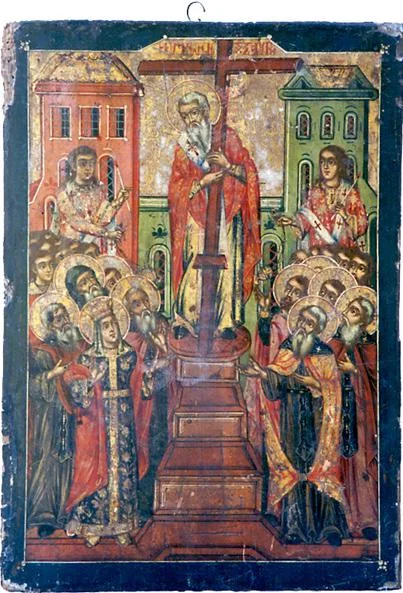
Choose a number on the icon, or a name in the list, to see what is painted there and what it means.
How the painters' Guide of Mount Athos describes it
«A temple. Within, St. Macarius, Patriarch of Jerusalem, upon an ambo, holding the revered cross of Christ. The empress St. Helena standing below the ambo; with her a number of princes, and a multitude of people gazing upwards with raised hands.»«This subject, which is one of the most imposing in Greek painting, is not sufficiently dealt with here. It is described more fully in the first volume of this work, at pages 414–417.»The Byzantine Guide to Painting, tr. M. Stokes, in Didron, Christian Iconography II (1886), p. 358
«Outside the sanctuary, all round the temple, on the right and left sides represent a selection of parables (see pp. 322 et seq.); and also the exaltation of the cross and the triumph of images.»The Byzantine Guide to Painting, tr. M. Stokes, in Didron, Christian Iconography II (1886), p. 387
The readings
- Vespers
- Vespers
- Vespers
- Vespers
- Orthros
- Epistle
- Gospel
- Gospel
- Gospel
- Gospel
The hymns of the feast
O Lord, save thy people, and bless thine inheritance. Grant unto the pious victory over the barbarians, and preserve thy commonwealth by thy Cross.O Zot, shpëto popullin tënd dhe bekoje trashëgimin tënd. Dhuroju shpresëtarëve fitore mbi barbarët dhe ruaje shtetin tënd me anën e Kryqit tënd
«Lartësimi i Kryqit ose Ngritja e Kryqit», the Church of Albania · translated by this site
O thou who of thine own will wast lifted up upon the Cross, ever grant grace unto the new commonwealth founded by thee, O Christ-God; give strength and gladness unto our people and state, grant them victory and triumph over their enemies in every war; be thou always an ally, a weapon for peace, an invincible trophy.Ti që u ngrite mbi Kryqin, duke dashur, shtetit të ri të themeluar prej teje, dhuroju kurdoherë hir, o Krisht Perëndi, jepi forcë dhe gëzim, popullit dhe shtetit tonë, fali fitore e triumf në çdo luftë mbi armiqtë; ji gjithmonë bashkëluftëtar, armë për paqe, trofe e pamundur
«Lartësimi i Kryqit ose Ngritja e Kryqit», the Church of Albania · translated by this site
What the Church says of it
«For us it is a day of fasting and prayer, a day that reminds us that the Cross is the only valid sign of all our loyalty, and that our salvation comes not from the “victories” of earthly things, but from the one true and lasting victory of the crucifixion of Christ and of our being crucified with him.»«Lartësimi i Kryqit ose Ngritja e Kryqit», the Church of Albania · translated by this site
«When we lift up the Cross and bow down before it in veneration and worship of God, we proclaim that we belong to the Kingdom “not of this world”, and that our true and lasting citizenship is with the saints in the “city of God” (Ephesians 2:19; Hebrews 11:10; Revelation 21–22).»«Lartësimi i Kryqit ose Ngritja e Kryqit», the Church of Albania · translated by this site
«Thus, at the Exaltation of the Cross, Christians formally rededicate themselves to the crucified Lord and promise him lasting loyalty, worshipping his holy feet, crucified on the life-giving Cross. This, in the Church today, is the meaning of this holy day of fasting and repentance.»«Lartësimi i Kryqit ose Ngritja e Kryqit», the Church of Albania · translated by this site
«Through Christ the Cross turned from an instrument of punishment into an instrument of salvation, from a symbol of a curse into “the abolition of the ancient curse”, through which our sins and trespasses were forgiven us (Colossians 2:14; Acts 13:38; 2 Corinthians 5:18–20).»«Kryqi», the Church of Albania · translated by this site
Read more on the site
- The Greeks Seek Jesus; the Grain of Wheat · the Gospel with the Fathers
- Behold the Man (Ecce Homo) · the Gospel with the Fathers
- The Crucifixion · the Gospel with the Fathers
- The Inscription and the Dividing of His Garments · the Gospel with the Fathers
- Woman, Behold Your Son · the Gospel with the Fathers
- The Seven Last Words from the Cross · the Gospel with the Fathers
- The Death of Jesus; the Veil Torn · the Gospel with the Fathers
- The Piercing of His Side · the Gospel with the Fathers
- The Crucifixion · a topic